I Tried Edge SSR in My React Vite App
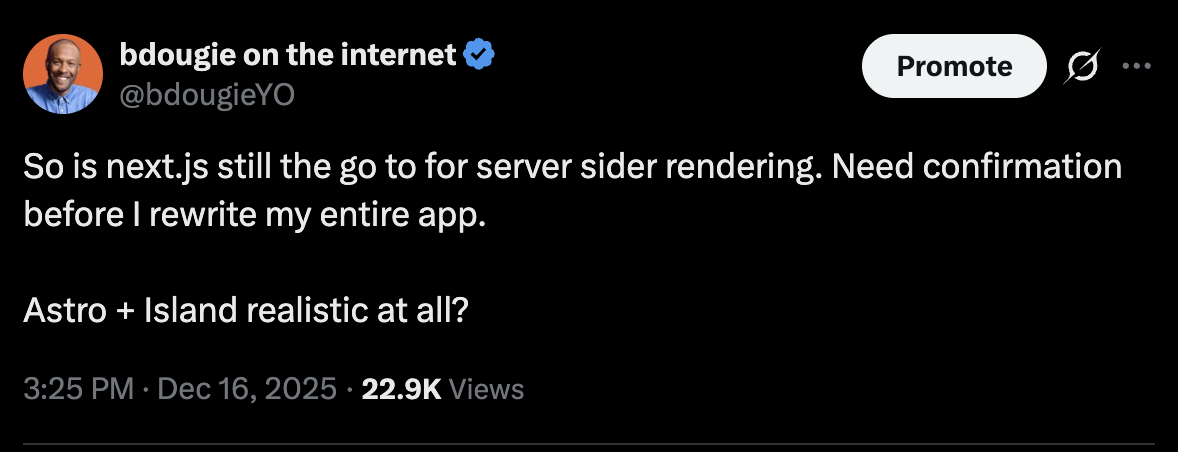
Two days ago, I posted about contributor.info’s performance challenges, particularly the 5.6 second Largest Contentful Paint (LCP) that was killing my SEO-critical pages. The responses pointed me toward modern frameworks—React Router v7 was hot, TanStack Start looked promising, and inevitably someone suggested “just rewrite it in Next.js.”
I tried them. I really did. But here’s the thing: contributor.info is a functioning product with real users, and I wasn’t ready to bet weeks of development time on a complete architectural overhaul when I only needed to optimize three routes.
The Exploration Phase
Following the X thread, I spent a day with React Router v7 (documented in PR #1374). The new framework features looked great, but migrating my entire routing setup felt like using a sledgehammer for a thumbtack. TanStack Start had similar appeal—and similar migration complexity.
The pattern became clear: every “modern” solution wanted me to rethink my entire application architecture. But contributor.info didn’t need rethinking. It needed faster paint times on the home page, trending page, and repository pages.
Finding the Right Tool for the Job
This is where working at Netlify for years paid off. Edge Functions kept nagging at the back of my mind. What if instead of rewriting the entire app, I just pre-rendered the critical paths at the edge?
The approach was pragmatic:
- Keep the existing React SPA architecture
- Add selective SSR only where it matters for SEO and perceived performance
- Use edge functions to minimize latency
- Maintain the SPA experience after hydration
The Implementation
The full implementation is in PR #1379. I created three targeted edge functions for my critical routes:
ssr-home.ts handles the landing page—hero card, repo stats, search input. All the above-the-fold content users and crawlers need.
ssr-trending.ts renders the trending repositories list, which is my second-highest traffic page.
ssr-repo.ts generates individual repository pages with detailed stats and contributor information.
Each function follows the same pattern:
import { fetchHomeData } from './_shared/supabase';
import { renderHTML } from './_shared/html-template';

const homeData = await fetchHomeData();
const html = renderHTML(homeData);
return new Response(html, {
  headers: { 'content-type': 'text/html' }
});
The client-side picks up seamlessly with hydration utilities:
import { hydrateRoot } from 'react-dom/client';
import App from './App';
import { ssrData } from './lib/ssr-hydration';

const rootElement = document.getElementById('root')!;
hydrateRoot(rootElement, <App initialData={ssrData} />);
Smart Caching
The edge functions use aggressive but smart caching:
- Trending page: 2-minute cache, 10-minute stale-while-revalidate
- Repository pages: 5-minute cache, 1-hour stale-while-revalidate
And crucially, if SSR fails for any reason, I fall back to the existing SPA:
try {
  const html = await renderSSR();
  return new Response(html, {
    headers: { 'content-type': 'text/html' }
  });
} catch {
  return new Response(await renderSPA(), {
    headers: { 'content-type': 'text/html' }
  });
}
The Results
LCP dropped from 5.6 seconds to under 2.5 seconds. That’s the headline number, but the real win is what I didn’t do:
- Didn’t rewrite the entire routing system
- Didn’t migrate to a new framework
- Didn’t introduce weeks of regression risk
- Didn’t change the developer experience for the 80% of pages that didn’t need SSR
Key Lessons
1. Modern doesn’t always mean better. React Router v7 and TanStack Start are excellent tools, but they’re solving for greenfield projects or teams ready for major migrations. Sometimes you just need targeted optimization.
2. Edge functions are underrated for selective SSR. Everyone talks about Vercel, Cloudflare Workers, or full framework SSR. But edge functions for just your critical paths? That’s a sweet spot a lot of developers miss.
3. Measure what matters. I didn’t need every page to be fast. I needed the pages Google crawls and users land on to be fast. That focused scope made the solution feasible.
4. Progressive enhancement still works. The SPA fallback means I never break the user experience, even if edge rendering fails. That’s not just good architecture—it’s respecting your users.
What’s Next
The edge SSR approach paid off—I’m now at a 98 Lighthouse performance score, up from the 5.6 second LCP that started this journey. Moving forward, I’m sticking with this pattern while upgrading to React Router v7 for better routing primitives.
I’ll also explore TanStack Start, mostly out of curiosity and as a chance to support and contribute to the growing ecosystem. But the core lesson stands: you don’t always need to chase the newest framework.
If you’re facing similar performance challenges, don’t let the framework hype train convince you that you need a full rewrite. Sometimes the best solution is the one that solves your specific problem without creating ten new ones.
The code is open source in the contributor.info repo—check out the netlify/edge-functions directory if you want to see the implementation details.
Want to chat about edge SSR, performance optimization, or whether you actually need that framework migration? Hit me up on X or check out the Open Source Ready podcast where we dive deep into topics like this.